Risk · CORAL
Dust risk forecast for bulk cargo
A dust risk forecast for the next 72 hours, hour by hour, for every terminal and cargo type. You plan water spraying, screens and rescheduling a day ahead, not when the dust is already in the air and residents' complaints are landing in your inbox.
A problem that returns with every strong wind
Dust from stockpiles and cargo handling operations is a fugitive emission. There is no single source that can easily be monitored, and its effects are felt above all by the plant’s surroundings. Reacting only after a dust episode has occurred is costly: suspended operations, residents’ complaints and inspections. A dust risk forecast makes it possible to plan preventive measures in advance, before dust is released.
Since 2018 the tool has been used by Poland’s largest ports.
What you get
- A 72-hour risk forecast at hourly resolution, in four levels, for every terminal and cargo type.
- Advance notifications when the forecast crosses an agreed level: e-mail, SMS, integration with the dispatch system.
- A view for the authority and a view for the operator: the port sees everything, the terminal sees its own berths.
- A log of warnings and actions: what the system recommended, what was done, what monitoring showed afterwards.
- Accuracy accounting: forecasts compared with PM monitoring data, so you know how many warnings were right.
Where the numbers come from
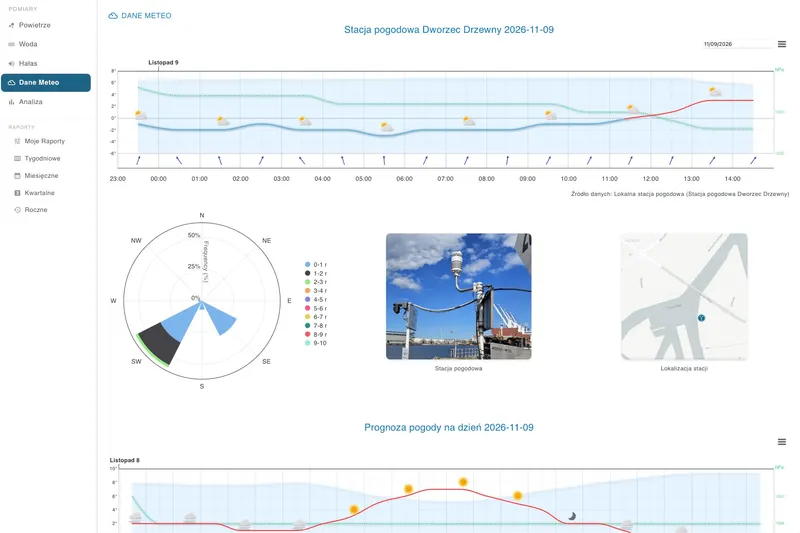
The model combines three sources. The first is the weather forecast from several numerical models: wind at stockpile height and gusts, humidity, rainfall, temperature and atmospheric stability. The second is the material and operation parameters: grain size, moisture, drop height, whether the cargo is sprayed. The third is local monitoring, where available: dust concentrations from monitoring stations and on-site weather data. Together they give an emission flux forecast, which is converted into a risk level for a specific place.
Same engine, other risks
The physics of wind lifting particles is universal. On the same basis we build forecasts for other weather-dependent processes: safe windows for work at height, frost risk, drought, conditions for construction work. If your problem depends on the weather, it can be forecast.
Sample forecast to download
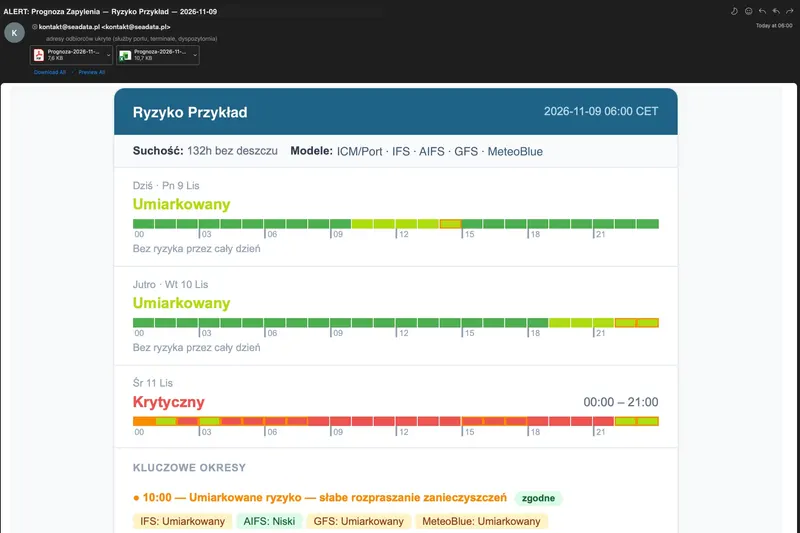
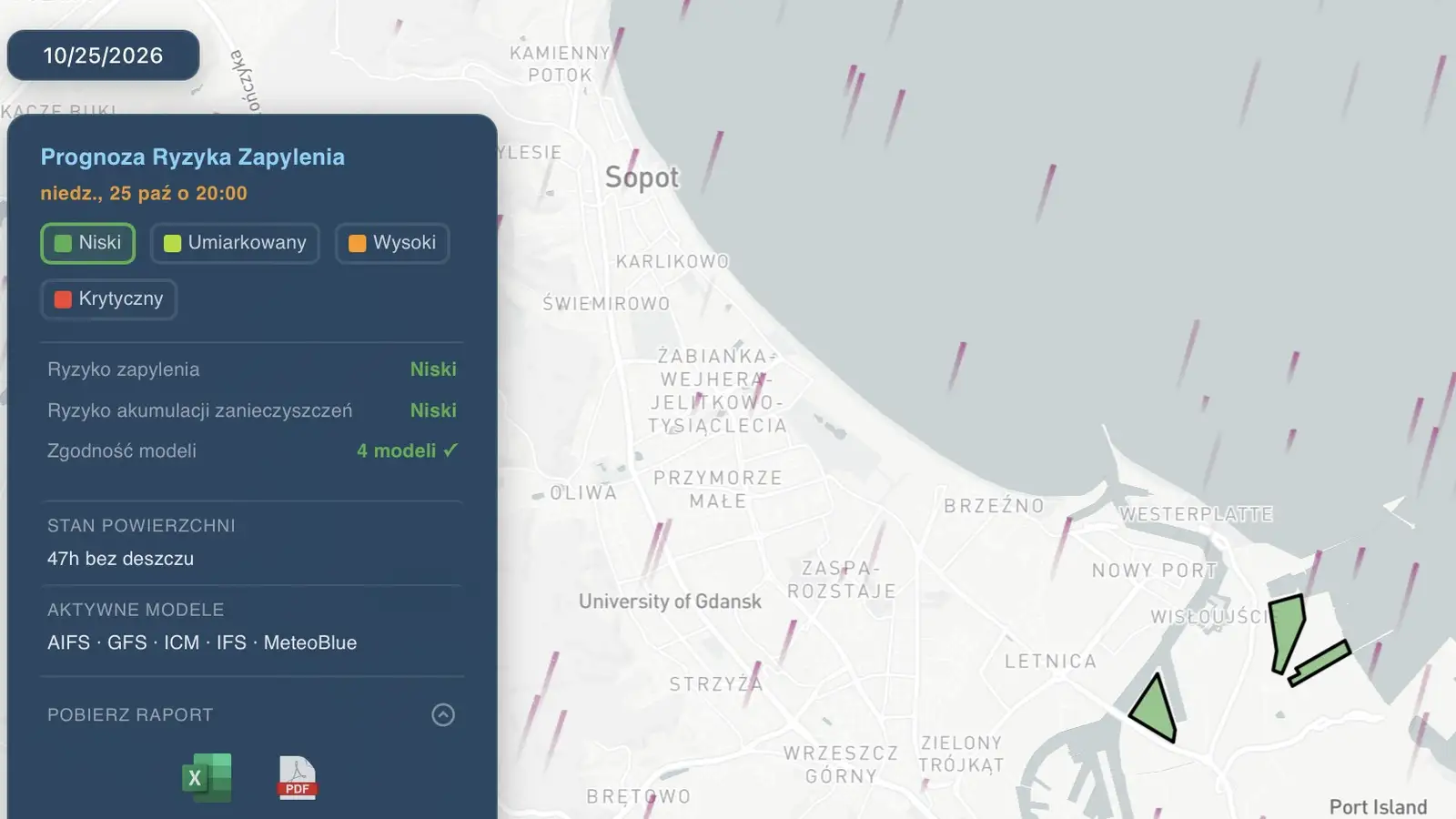
This is the daily forecast a client receives by e-mail at 6:00: a PDF report with the risk level for three days, key periods and model agreement, and hourly XLSX data with dust and accumulation risk, wind, temperature, CAMS PM10 background and the results of each model. The sample is anonymised.
Physics instead of gut feeling
The model computes particle detachment from stockpiles and cargo streams from wind speed and gusts, material moisture, rainfall and temperature. Separate parameters for coal, ore, fertiliser and aggregates.
Several weather models, one answer
Instead of trusting one forecast we combine several numerical models and show how far they agree. When they diverge, the risk rises and we say so.
Calibrated on your monitoring data
If you have monitoring stations, the model learns from local PM data and improves its accuracy week by week.
Cargo handling schedule
The risk depends on what you handle and how. You enter operations into the calendar or we connect your terminal system.
Multi-terminal map
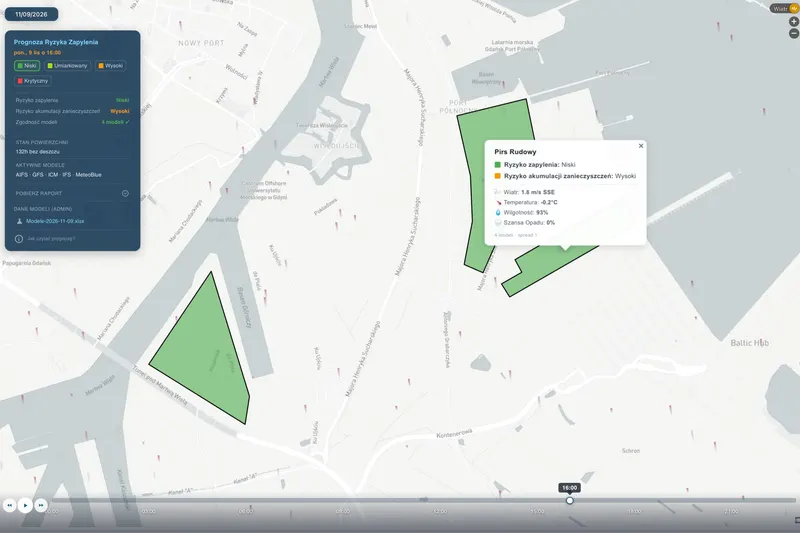
The port authority sees all terminals at once, each operator sees its own. Risk levels and notifications for each of them separately.
Record of actions
Every warning and every action taken stays in the log. Evidence of due diligence for the inspectorate and for residents.
What it looks like in the platform